The short version: Daylight saving time ends at 2 a.m. on Sunday, Nov. 1, 2026. Sunset in Texas cities moves from roughly 6:35–6:50 p.m. on Halloween to roughly 5:35–5:50 p.m. the next day, so the after-work run that ended in daylight in October starts near dark in November. Mornings get brighter for a few weeks, then darken again toward December. Texas crash data say this is the time to get visible: 67% of serious or fatal pedestrian crashes in Texas happened at night in 2024, according to TxDOT.
Sunset and sunrise, before and after the change
These are the sunrise, sunset and end-of-civil-twilight times (when it is effectively dark) on the last day of daylight saving time, the first day of standard time and the shortest day of the year.
| City | Sat., Oct. 31 | Sun., Nov. 1 | Mon., Dec. 21 |
|---|---|---|---|
| Houston | Sunrise 7:33 · sunset 6:37 · dark 7:00 | Sunrise 6:34 · sunset 5:36 · dark 5:59 | Sunrise 7:11 · sunset 5:28 · dark 5:53 |
| Dallas | Sunrise 7:43 · sunset 6:39 · dark 7:03 | Sunrise 6:44 · sunset 5:38 · dark 6:02 | Sunrise 7:24 · sunset 5:27 · dark 5:52 |
| Austin | Sunrise 7:43 · sunset 6:46 · dark 7:09 | Sunrise 6:44 · sunset 5:45 · dark 6:08 | Sunrise 7:22 · sunset 5:36 · dark 6:01 |
| San Antonio | Sunrise 7:45 · sunset 6:50 · dark 7:13 | Sunrise 6:46 · sunset 5:49 · dark 6:12 | Sunrise 7:23 · sunset 5:41 · dark 6:06 |
| El Paso (Mountain) | Sunrise 7:20 · sunset 6:19 · dark 6:42 | Sunrise 6:21 · sunset 5:18 · dark 5:42 | Sunrise 7:01 · sunset 5:08 · dark 5:33 |
Times are rounded to the minute from Sunrise-Sunset.org for each city center. The practical read: a runner who leaves work at 5:30 in Dallas or Houston gets maybe 30 minutes of usable light in early November, and less by mid-December. Morning runners get the opposite deal: sunrise moves an hour earlier on Nov. 1, then creeps back past 7 a.m. by late November in Dallas, Austin and San Antonio.
Why the switch matters for people on foot
TxDOT calls October the deadliest month for people walking in Texas. In October 2024, 89 people were killed while walking on Texas roads and 143 were seriously injured; 773 died across the year. The agency says 67% of serious or fatal pedestrian crashes in the state happened at night that year.
The national picture points the same way. The Governors Highway Safety Association's 2025 report found that in 2024, 76.5% of U.S. pedestrian deaths with known lighting conditions happened after dark, compared with 19.9% in daylight. Its state survey notes that some states saw pedestrian crashes increase at the end of daylight saving time. There is some good news in the same report: GHSA's preliminary count for Texas fell from 772 pedestrian deaths in 2024 to 700 in 2025, a 9.3% drop.
Runners are pedestrians in those numbers. A dark-colored long-sleeve that felt right in October's heat is close to invisible at 6 p.m. in November.
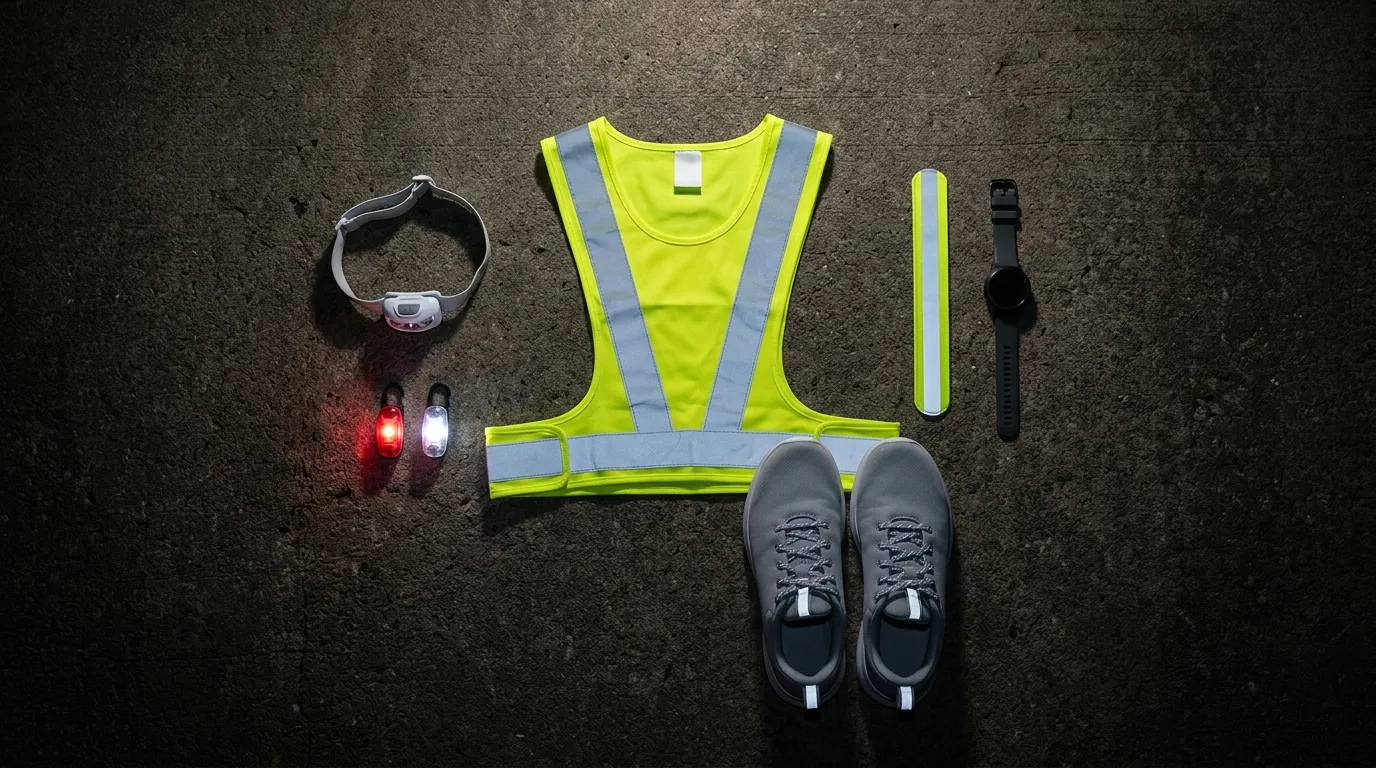
The visibility checklist
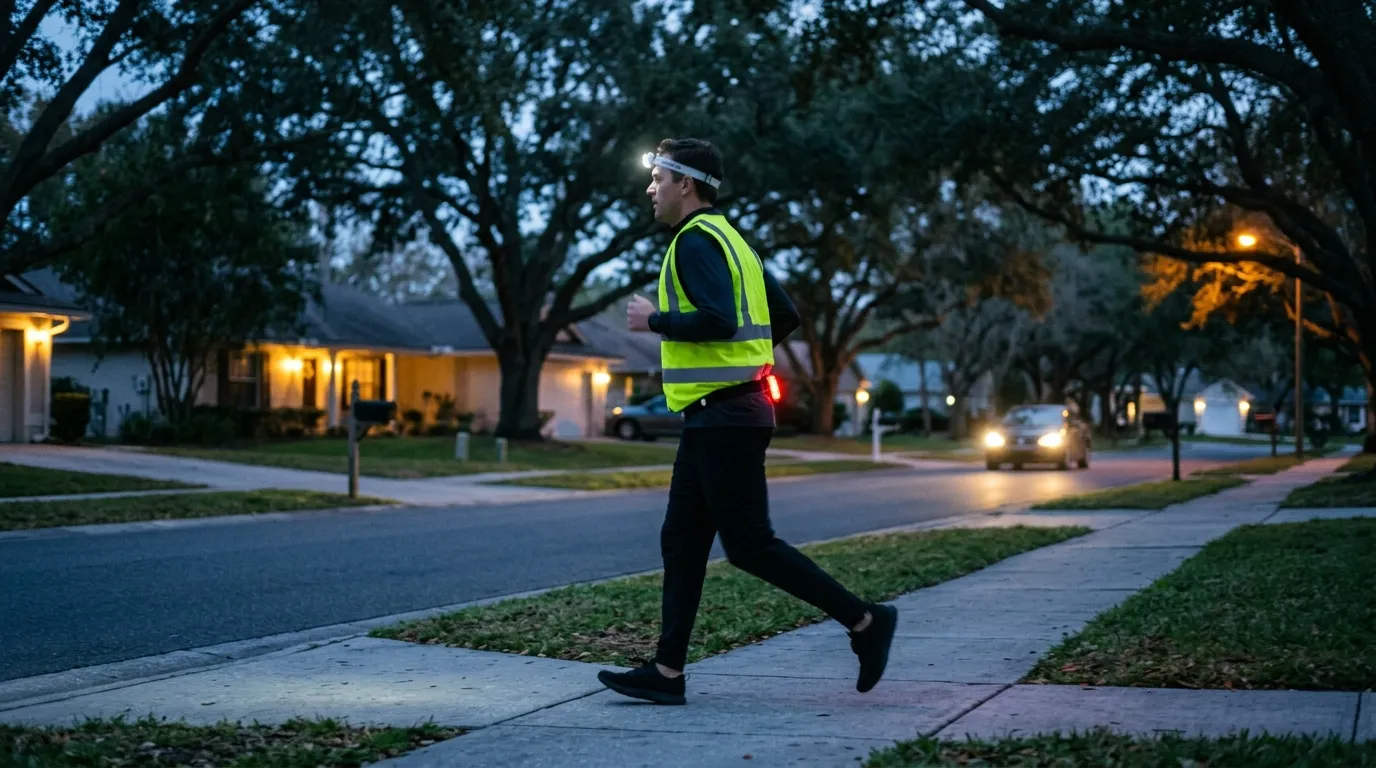
- Light in front, light behind. A headlamp or chest light lets you see broken sidewalk and lets drivers see you coming. A blinking red clip light on your back or waistband covers cars approaching from behind.
- Reflective on the parts that move. Reflective bands on ankles and wrists bounce headlight back in a running motion drivers recognize. A reflective vest adds a big surface for very little weight. TxDOT's own advice for walking at night is to wear reflective materials or carry a flashlight.
- Face traffic when there is no sidewalk. You see the car, and the driver sees your front light. On a sidewalk or trail, stay there.
- Cross where drivers expect you. TxDOT's tips: use intersections and crosswalks, make eye contact with the driver before you step out, look left, right and left again, and do not assume a car will stop. Large SUVs and pickups have big front blind spots.
- One earbud or none. TxDOT tells people walking to put phones and earbuds away. If you need music, keep the volume low enough to hear an engine.
- Change the route, not just the outfit. Move dark runs to lit trails, tracks or neighborhoods with sidewalks, and save unlit country roads for weekend daylight.
Where to run when it is dark early
Group runs are the easiest fix: more lights, more eyes and a route someone has already scouted. Our Run Houston guide lists Houston clubs and weekly group runs, and our Texas running-store directory can help you find a local shop to ask about evening group runs and try on lights and vests. Check our fall trail detours before you plan a loop around Lady Bird Lake, Memorial Park or White Rock, so a closure does not send you onto an unlit road.
It is also the right season to slow down. If your easy runs get pushed into the dark, there is no reason to chase pace on bad footing; our zone 2 explainer makes the case for slow running, and the run-walk method works as well in November as it did in August.
Will this be the last time change?
Not this year. The U.S. House passed the Sunshine Protection Act (H.R. 139), which would keep most of the country on daylight saving time year-round, by a 308–117 vote on July 14, 2026. As of late September it was in front of the Senate Commerce Committee and was not law. Unless that changes before Nov. 1, Texas falls back as usual.
Race mornings in November
The time change helps early race starts. With sunrise near 6:35–6:45 a.m. right after Nov. 1, a 7 a.m. start gets real daylight. That covers the first weekend of November races, from the Día de los Muertos runs on Nov. 1 to the Fort Worth Marathon on Nov. 7, plus Veterans Day races (our Veterans Day 2026 roundup lists all 15). By Thanksgiving (Nov. 26), sunrise is back to about 7:05 a.m. in Dallas, Austin and San Antonio and 6:54 in Houston, so headlamps are worth packing for early turkey trot warmups. Our turkey trot 5K plan still has time to run.